Cārika 2026-07
Translated from Chinese version by DeepSeek.
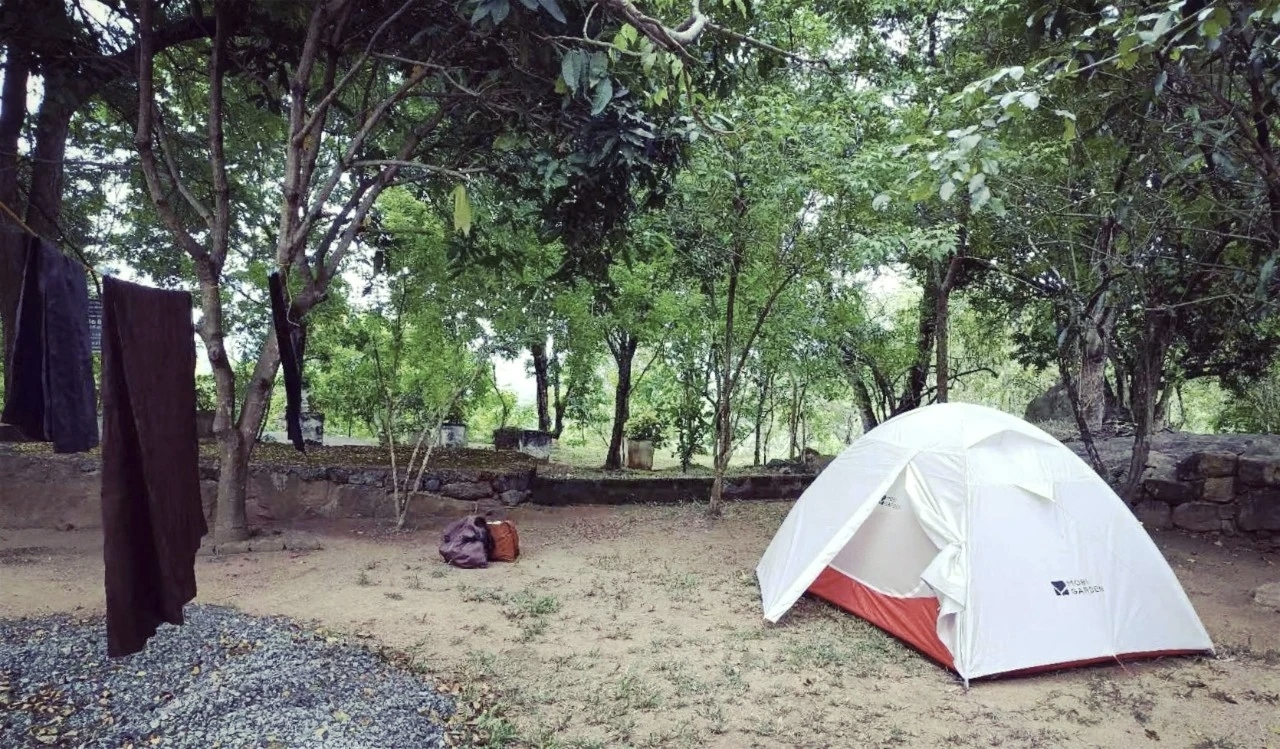
Today is July 14, 2026. Venerable India Dīpaloka and I have just finished a two-week cārika. We walked roughly two hundred kilometers from the main monastery at Nauyana Forest Monastery to another monastery. I would now like to offer a brief summary and some reflections.
Origins and Preparation
This was our first cārika. The occasion arose because there was a three-month silent meditation retreat at that monastery—essentially a rain retreat. Since the distance happened to be about two hundred kilometers, a very suitable distance for a first try, we seized the opportunity and asked the mahathera for permission.
About a month before setting out, we began preparing: organizing our packs, building up our leg strength, practicing sleeping in a tent, and so on.
At the time, we met some fellow practitioners who, upon hearing that we planned to walk from the main monastery to the branch monastery, were puzzled and asked why. After all, one can get there by vehicle in a few hours, whereas walking takes two weeks—or at least one week if you are a strong walker.
Why Walk in an Age of Convenience?
During the cārika, we often encountered laypeople who asked the same question: with technology so advanced and transportation so convenient, why walk? Especially in a country like Sri Lanka, which is very supportive and friendly toward Buddhists: when monastics travel, there are often many laypeople willing to support them, drive them, or provide travel funds. So such a cārika seems entirely unnecessary.
Moreover, when you actually walk, you do encounter many difficulties: wind and sun, rain, fatigue, and illness—all of these may arise. And when they do, the thought may arise: “Isn’t this just looking for trouble, looking for suffering when there is none?” These factors are probably why there are fewer and fewer wandering monks today.
Perhaps only two kinds of people still go on cārika. One kind consists of practitioners who have some pāramī related to the ascetic practices (dhutaṅga). Having read some historical stories and seen how walking monks in the past—such as the Buddha and the arahants—behaved, they feel a spontaneous aspiration to become walking monks. The other kind is perhaps people like Venerable Dīpaloka and me: from the perspective of dependent origination, from the perspective of wisdom, we have observed how this body and mind and the world actually come to be, how suffering in this world actually comes to be, and how all phenomena in this world actually come to be. Entering from that angle, one may see the value of cārika as a way of practice.
Four Noble Truths and the Wisdom Core of Cārika
Before this cārika, Venerable Dīpaloka and I had held more than twenty discussions on the Dharma, mainly centering on the Aṭṭhakavagga and parts of the Pārāyanavagga from the Khuddakanikāya of the Pali Canon. The theme of those discussions was to use modern science—including cybernetics, second-order cybernetics, and other advanced frontier theories of complex systems in cognitive science—to help understand the deeper meaning of the Four Noble Truths and dependent origination as revealed by the Buddha. If one has some understanding of them, one may understand why we chose to undertake such a walking practice.
Simply put, this way of practice returns your body, mind to a setting with very little external support. As a result, all the hidden suffering accumulated from the past will be triggered. If one normally lacks training and suddenly walks a long distance, the body will experience all kinds of pain. This time I experienced soreness in all my muscles and joints and inflammation of the soles of my feet; all of these occurred.
If you understand how these problems arise and can apply the Four Noble Truths and dependent origination to these phenomena, then you can maintain mindfulness and continue walking. Of course, you may use appropriate means, such as treatment or rest, but you still continue. Then the origin of suffering gradually subsides, and the body becomes lighter and more at ease, because its dependencies become fewer and fewer. Moreover, during wandering, you cannot carry many things, because you have to carry everything yourself, so the fewer dependencies the better. We reduceed our requisites a great deal, but after actually setting out we found our load was still too heavy, so two days into the journey I threw away about one third of my things. This trains an attitude and behavior of renunciation befitting a monastic.
Making Practice Real
When people talk about the Dhamma, it seems very complex: there can be thousands of suttas, or even more in the Mahayana Mahāpiṭaka. But in fact, the core content of the Dhamma—the Four Noble Truths—is very simple: clinging is the cause of suffering; if you let go, you are free from suffering. For example, the purpose of practicing sīla, concentration, and wisdom is all to see through and let go. And what this wandering life gave is this: it makes practice very real. It is not like that you can talk a lot of theory, sit in meditation very well, have some wisdom, and discuss all sorts of treatises, but in fact, if the environment is slightly uncomfortable, the food not so good, the temperature unsuitable, or you are too tired, you cannot bear it.
During the pilgrimage, all that is false cannot be hidden. Every day you have to walk for a long time. Because of the precepts, you do not use money, so you must obtain your daily food by almsround. When you are tired, you may not even find a place to rest, because the surroundings are shops, and in the countryside there are people’s private residences, orchards, and farmland—everywhere is occupied, and it is hard to find a place to rest. Even if you find a forest, it often has dense vegetation or various animals, and not many places are suitable for rest. So you have to face a great deal of physical discomfort.
At that point you can see that the furniture, tables, and chairs we are used to in daily life actually carry many dependencies and provide much comfort. When they are absent, you feel great discomfort. So this path of liberation—gaining freedom from suffering by letting go of attachment to pleasures and to various conditions—can become very real during a walking pilgrimage. If you can face it and transcend it, you can gain this freedom. You truly let go of dependence on all the support and comfort provided by civilization.
Why Do Monks Not Go on Cārika?
If you read the Buddhist scriptures, this is actually one of the proper aspects of a renunciant monk’s life. For the very meaning of bhikkhu is “one who lives on almsfood” (or “one who wanders and begs for food”). In Indian culture it was originally a term for a way of practice that abandons household life and lives on alms. So for a bhikkhu, rather than asking “Why do you go on walking cārika?”, one should really ask “Why do you not do it?” This, then, is my answer to the commonly asked question “Why go on cārika?”
Specifically regarding this pilgrimage, we did encounter some difficulties—for example, physical illness. It was so sick that my whole body ached and my joints were sore; when going downstairs I had to hold the railing. At that time, the abbot of a village temple took us to see a doctor. I took some medicine, felt relief the next day, and then continued on the road.
If a person normally lives in a fairly good environment and then undertakes this kind of high-intensity walking—though ours was not really high-intensity, for someone who has never walked pilgrimage before the intensity is still considerable—the body will experience various discomforts (overheating, inflammation, fatigue, etc.). Then, as these discomforts arise, the mind will produce all kinds of doubt and affliction. In addition, two people walking together will also encounter some friction and challenges. But because we both have the Dhamma, we can quickly reflect and introspect, and see what is the direction of wisdom and what is the interference of affliction, so we can transcend them. These were some of the challenges encountered on this trip.
Route and Daily Rhythm
We did our homework in advance on the route. Generally, people recommend following the main road; there is also another road through a less populated forest reserve; and there are roads somewhere in between. We ultimately chose the middle way—neither the main road nor the sparsely populated road. Because we felt our experience was not extensive, we chose a route that was about 50 percent rural, with many rubber and coconut plantations, tea gardens, and farmland, and occasionally some main roads or commercial areas.
Each day we walked about 15 to 20 kilometers. We usually set out around five in the morning, when the sky was just beginning to brighten, because early morning is the best time for walking. We would walk until about eight or nine o’clock—four or five hours—resting briefly when tired. If someone offered breakfast (porridge or bread, etc.), we would stop and find a place by the roadside to eat, and then continue walking. Around nine or ten o’clock we could begin our almsround, and afterward find a place to eat. Because we needed to wash our bowls, we generally looked for a monastery to eat at, or else borrowed a farmer’s home to eat or wash our bowls. It was hard to find a completely natural forest environment with a stream where we could wash our bowls after eating; on this route, such places were rarely unavailable.
The same applied to lodging. We brought tents, and at first we planned perhaps to stay under some trees, but in reality we could not find suitable places. Many places were either plantations or private residences. So in the end we mostly chose to pitch our tents in village temples.
Benefits and Reflections
Overall, I felt this was a rather difficult cārika. At the same time, there were great benefits: we were able to see how the body and mind react when challenged during the trip, and to apply the Dhamma and see the power of the Dhamma. We could also see how the areas we had practiced correctly before were helpful for the trip.
For example, since ordaining, whenever I could go on almsround, I would go, sometimes walking very far, barefoot, so my leg strength had some training. Also, when I lived at the Middle Mountain area at Nauyana, almsround often involved going down and up the mountain, which also gave some training in physical stamina. Without these foundations, this pilgrimage would probably have been impossible to complete. Also, the insight and mindfulness practice I had done previously when sickness arose was an indispensable prerequisite for being able to continue walking and recover quickly when illness occurred during the trip.
At the same time, I also saw some shortcomings: this kind of cārika itself did not reach the level of balanced meditation practice—that is, treating walking as meditation and using half a day after each day’s walk for formal meditation was basically unattainable. Because the body was in a very fatigued state, and in addition we had to do a lot of route planning (where to walk, where to stay, etc.), the mind was not in a very meditative state. There were external causes—the route we chose itself had this characteristic; it was not a particularly natural environment or a sparsely populated path. But there were also internal causes: mindfulness and samadhi practice can still be improved.
Future Outlook
I plan to do another cārika after the rain retreat when I return to Nauyana. I may choose a less populated road and try something different. The ultimate goal is still to find a way of practice similar to that of the original bhikkhus: not continuous wandering, but also not long-term residence in a single monastery. One would wander freely among different forest monasteries. And while wandering, one would not be in such a hurry as this time, when there was a deadline to arrive. It could be done in stages: for example, spend several days walking to a forest monastery, practice meditation there for several days, weeks or even months, and then continue to the next monastery. This staged way of moving while practicing meditation, I feel, would be closer to a cārika bhikkhu’s life—not a way of rushing along the road, and not involving daily contact with large numbers of laypeople and modern civilization, which are actually not very suitable for a meditating monk. This was our first try, so encountering these situations is entirely normal. We have also gained a general understanding of the current external conditions and our own state.
At present, I think Sri Lanka is a relatively good country for training in the beginnings of wandering life, because the support base of the faithful here is very good, and they are all very willing to help monastics. But the level may differ from region to region—some places higher, some lower. This is actually good, because it can train a person’s mind in the various tests of encountering kindness or unkindness from others during almsround or on the road. But on the whole, there are still very many laypeople willing to help renunciants.
So food is not a problem. People often even want to give you a ride, but because this time we were on cārika, we did not accept any offers of rides. Moreover, Sri Lanka has a nationwide system of village temples, which is itself a resource for wandering. On the other hand, one should not overly depend on these places. Management level of village temples varies: some environments are rather cluttered, while others are well organized.
Later I may try to find some forest monasteries, because this time we stayed along the road and then quickly set out again, without going deep into the forest. If one goes deeper or into the mountains, one should find some forest monasteries more suitable for meditation, or places where one can stay for a few weeks or a little longer. Once these places become familiar, the quality of the cārika itself will also change.
I think this spirit of wandering—sometimes called the ascetic spirit—is not necessarily only useful during cārika. It is actually the core content of the Four Noble Truths, dependent origination, and the four foundations of mindfulness: when the six sense faculties meet their objects, one sees the danger in all these good and bad phenomena, in greed and aversion, and so on, and one keeps the mind dwelling in the wisdom of the Dhamma, not turning with greed and sorrow. This is the core spirit of wandering. But this spirit itself does not necessarily have to be applied only during wandering. When you are staying in a monastery, or even living at home, you can apply it as well.
I think one point that may be of some reference for everyone is this: if today you can regard the place where you live as a temporary dwelling—that is, often imagine yourself to be on a cārika, like a traveler—then your hoarding mentality will decrease and your letting-go mentality will increase. Then wherever you are, you can be an ascetic from inside.
Practitioner: Venerable Sir, in your 18th talk you mentioned that some monasteries have too many duties, so that one cannot do one’s meditation work. In cārika, one feels that practice has become real. Is this somewhat similar to “Zen in daily life,” but compared with duties, it requires more of a mind of renunciation toward all clinging? And in a monastery, duties, if one is not careful, may instead encourage clinging, such as hoarding things?
Ṭhitavīro: Nowadays monasteries are sometimes a bit luxurious in their facilities. For example, the monastery we arrived at is built on a mountain top over 700 meters above sea level. It feels almost like a star-rated hotel: all the finishes are of the best materials, floor tiles, and the washing utensils are brand-name and brand new. For ordinary people, arriving here they might feel very happy: “I have finally found a place for practice with a good environment.” But in fact, if you understand dependent origination, you will have a different view.
Because having such a luxurious place on a mountain over 700 meters high, surrounded by beautiful scenery, the maintenance cost is extremely high. You need a large amount of funds to maintain this place. I heard that after this place was built, it was handed over to another monk, but no maintenance funds were provided. So this elder now has to expend great effort and energy maintaining this monastery, and the monks all have to continually do various construction activities (paving roads, painting walls, connecting electricity, repairing water pipes, etc.). All these maintenance problems must be done by themselves, because there is no funding.
Even if the faithful donate money to you and you can hire others to do it, that is also inappropriate. For a bhikkhu, this is renunciant life, not household life. These household things themselves come at a cost. All the ordinary people live in very poor places, while here you have a very luxurious place and still need others to support you. This is not in accordance with the Four Noble Truths and dependent origination.
Practitioner: Yes, maintaining a “home” is very tiring.
Ṭhitavīro: Doing this is equivalent to exhausting merit. You have to think about the reason for this. So many of the duties in monasteries come from excessive luxury in environmental construction. Too many unnecessary things have been added to the monastery’s system and facilities, and all these things actually need maintenance and cleaning, and then there are many duties.
On the other hand, when you live in a monastery with such good facilities, the scriptures you study all speak of renunciation, letting go, and simple living. But in fact, the place you live is very comfortable, the meditation hall is very large, the floor is spotless, and the facilities everywhere are very pleasant. This is what I meant in my sharing: this kind of practice lacks a sense of reality. You talk about letting go, but in fact your environment is very superior, and every day you are pretending to yourself that you are practicing.
For example, the precepts say that a bhikkhu should not store food. So if someone offers food every day, at noon it must all be relinquished. In a monastery, this means moving all the food from one table to another. The next day, when laypeople come, they give it to you again, and you move it back to another table. The actual result is that you can keep using it 365 days a year without any problem. This is what I meant when I said this practice lacks a sense of reality. But on a cārika, this is impossible: you cannot carry a pile of food with you every day, because just carrying the requisites is already very tiring. So after eating, you immediately relinquish all left food. In this way, the Buddhist precepts become very pragmatic, and practice becomes very true-to-life.
Simply put, a bhikkhu is a renunciant. During cārika you can truly feel that you have left home, that you have no home, and that you must let go of all clinging to home—all the good food, beautiful things, and comforts are gone. If you do not let go of these clingings, you will suffer greatly; if you let go, you may be free from suffering. So this is what I meant earlier when I said that wandering makes practice very real.
Practitioner: So the wandering life is in accordance with and suited to the original Dhamma.
Ṭhitavīro: Yes, the bhikkhu’s wandering way of life and the original four foundations of mindfulness practice are two sides of the same coin.